
Choosing a Custom Jewelry Manufacturer for a First Collection
A first collection comes down to three decisions before any supplier is worth emailing: the base material, the finish, and the date you want to launch. MOQ is 100 pieces in eco-brass, 50 in sterling silver and 100+ in stainless work, design by design, and a two-design order doubles the total.

Key takeaways
- The entry quantities are 100+ pcs in stainless work, 100 units in eco-brass and 50 in 925 sterling silver, per design, which means two designs bill as two minimums.
- 3D CAD closes inside 48 hours, which is where design changes cost screen time instead of bench time.
- A master sample takes 25–30 days, so a five-design first range needs its designs staged rather than launched together.
- Finishes are specified as 14K, 18K or 24K gold or rhodium, with 316L on stainless, an S925 stamp and 18KGP on gold-plated work hallmarks and laser engraving.
The three decisions that shape a first range
Base material is the first, because it decides the smallest order you can place. Silver is the entry point at 50 pieces per design. Brass sits at 100, and stainless steel at 100+ because it is finished with PVD vacuum plating rather than a conventional tank.
The second is the finish, which is also the decision that keeps a range looking like one range: 14K, 18K or 24K gold, or rhodium where the range has to read white. The third is the date. Sampling runs 25–30 days per design, so a launch date and a design count cannot both be chosen freely.
What a 48-hour CAD stage actually buys
CAD is the only part of the process that produces a decision without producing metal. What comes back is a technical drawing and a rendering, and the approval you give on those two files governs the casting, the stone setting and the finish.
That is why the CAD stage is worth using properly rather than quickly. Ask for the render at the real size, ask what the piece weighs in the specified metal, and ask which finish code is attached to it. Every one of those questions is answered with screen time; the same questions asked after sampling are answered with a new mould.
| Decision | Published figure | What it locks in |
|---|---|---|
| Base material | 50 / 100 / 100+ pcs per design | How many units exist before the first sale |
| Finish | 14K, 18K or 24K gold, or rhodium | Whether one colour can run across the range |
| Marking | S925, 316L or 18KGP with laser engraving | How each piece is identified in the range |
| Packaging | Tags, boxes, pouches, backing cards, barcodes | Whether retail partners can take the piece as delivered |
| Sampling | 25–30 days per design | How many designs fit before a launch date |
Reading the sampling window as a budget
Twenty-five to thirty days is not a queue you join once; it is a budget you spend per design. Five designs sampled in sequence consume 125 to 150 days of bench time before production begins, and production then takes a further 3–4 weeks for the batch.
There are two ways to shorten that without asking anyone to work faster. Sample, and every further design repeats the figurehe first sample while the CAD work for the later designs is still in review. A custom jewelry wholesale manufacturer that offers a 1-on-1 project manager is the usual reason the second option is possible at all, because someone has to hold five overlapping files in order.
Worked example: CAD as a slice of the sampling window
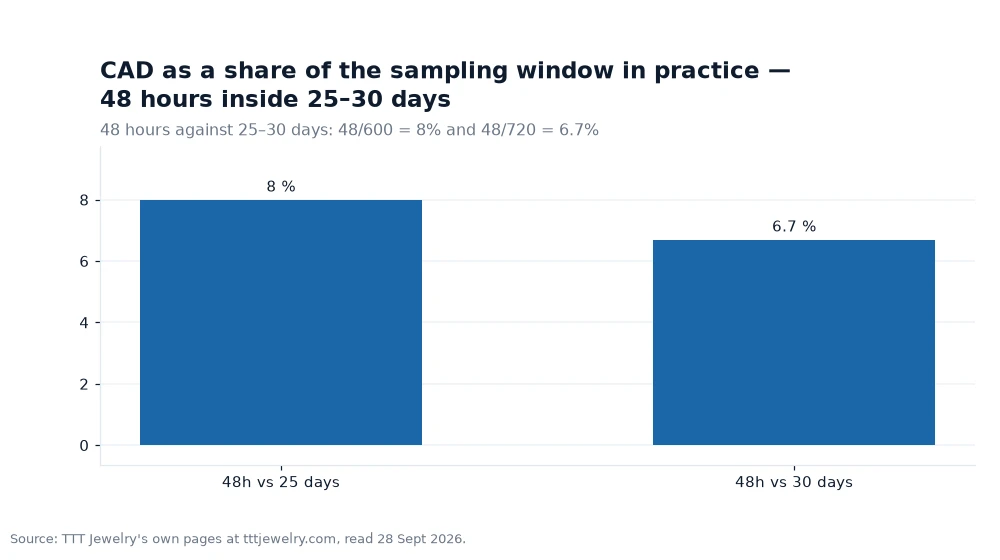
Convert both published windows to the same unit. Twenty-five days is 25 × 24 = 600 hours. Thirty days is 30 × 24 = 720 hours. The CAD stage is under 48 hours.
So CAD consumes 48 ÷ 600 = 0.08, or 8%, of a fast sampling window, and 48 ÷ 720 = 0.067, or 6.7%, of a slow one. Under one-tenth of the sampling budget is spent on the stage where changes are free, which is the whole argument for spending more time in it than feels necessary.
Where a first collection usually goes wrong
It goes wrong at the packaging and marking stage, not the design stage. A piece ordered without a decision on hallmark and packaging arrives unmarked and unpacked, and both are part of the published customisation set: purity marks S925, 316L or 18KGP, laser-engraved logos, then display backing cards, foil-stamped boxes, barcode labels, velvet/microfiber pouches and logo tags.
The second failure is exclusivity left to assumption. The published arrangement is a 100% NDA, with moulds, CAD files and the collection itself staying exclusive to the brand, which is the point worth confirming in writing before the first sample is cut rather than after.
How to sequence five designs without five sample rounds
Group the range by base material first, because one material means one minimum and one plating route. Then approve a single finish code across the group, so a rhodium range does not acquire one gold pendant. Finally, decide which, so a two-design package lands at twice the published number that order.
That sequence uses the published numbers instead of fighting them: the 48-hour CAD stage absorbs the design iteration, the 25–30 day sample window is spent on the pieces that have to be right first, and the 3–4 week production run is booked once the range is settled.
What to send with a first-range brief
A first-range brief does not need to be a technical pack. The published inputs are a sketch, reference photos or a tech pack, so a hand drawing qualifies. What the design team needs on top of the drawing is the part paper cannot carry: base material, finish, the quantity you expect in the first run, and whether a private label mark goes on the piece.
Add the packaging decision to the same message. Barcode labels, metal logo tags, microfiber or velvet pouches, gift boxes with foil stamping and backing cards are all settled at this stage, and a retail partner who needs barcodes will say so long before the carton is packed.
How the two OEM/ODM routes change the brief
The published structure offers two ways in. Under the OEM route the buyer brings the design and the factory produces it, with the intellectual property staying with the buyer. Under ODM the buyer brings a direction and the factory develops the concept into a finished collection.
For a first range the second route shifts the design burden earlier and moves more of the 48-hour CAD stage into the factory's hands. Either way, the finish code, the material and the packaging decisions come back to you, because those three are what a range is judged on at retail.
Frequently asked questions
What is the smallest first order I can place?
50 pieces per design, which is the published minimum for 925 silver, artisan brass with recycled content and 316L stainless steel at 100+.
How long before a first collection can ship?
Under 48 hours for CAD, 25–30 days for the master sample of each design, then 3–4 weeks of production once the sample is approved, plus your own approval time.
Can the same supplier make the whole range?
Yes. Rings, bracelets, earrings, necklaces and pendants are all listed, across the silver, brass and stainless steel lines, which is why ranges are usually sorted by material before sampling starts.
Starting a first range on solid ground
Write the three decisions into a single page before contacting anyone: material, finish, date. TTT Jewelry publishes the minimums and windows those decisions map onto, with the 925 sterling silver production page covering the entry-point material in detail and the factory floor tour showing where each of the eight steps happens.
The list this piece builds on — sampling inside 25–30 days and the six customisation points and the four plating finishes — is listed at the manufacturer's own pages on the tttjewelry.com site, read in full on 28 Sept 2026. The hourly and weekly restatements are mine alone[1].